

Through inspiring content, practical knowledge, and an expert community, we connect professionals, innovators, and enthusiasts who want to change the way we build.
Our mission is clear: to digitalize construction – together, smartly, and sustainably.
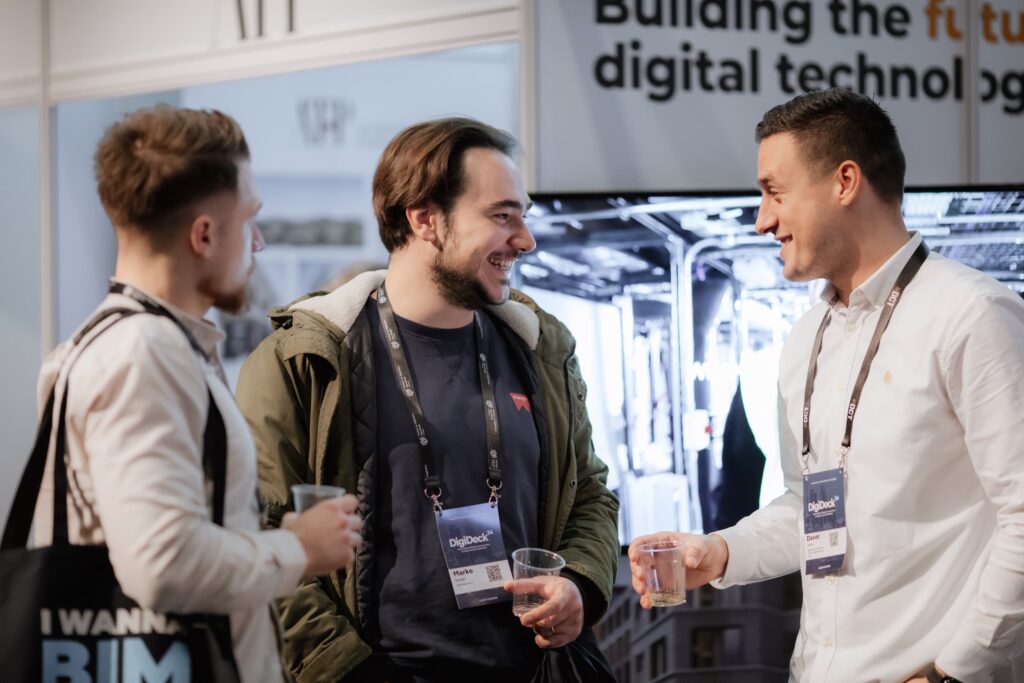
Connect and share experiences with more than 500 construction professionals! Find all the key information about the digitalization of the industry and the next steps – all in one place.
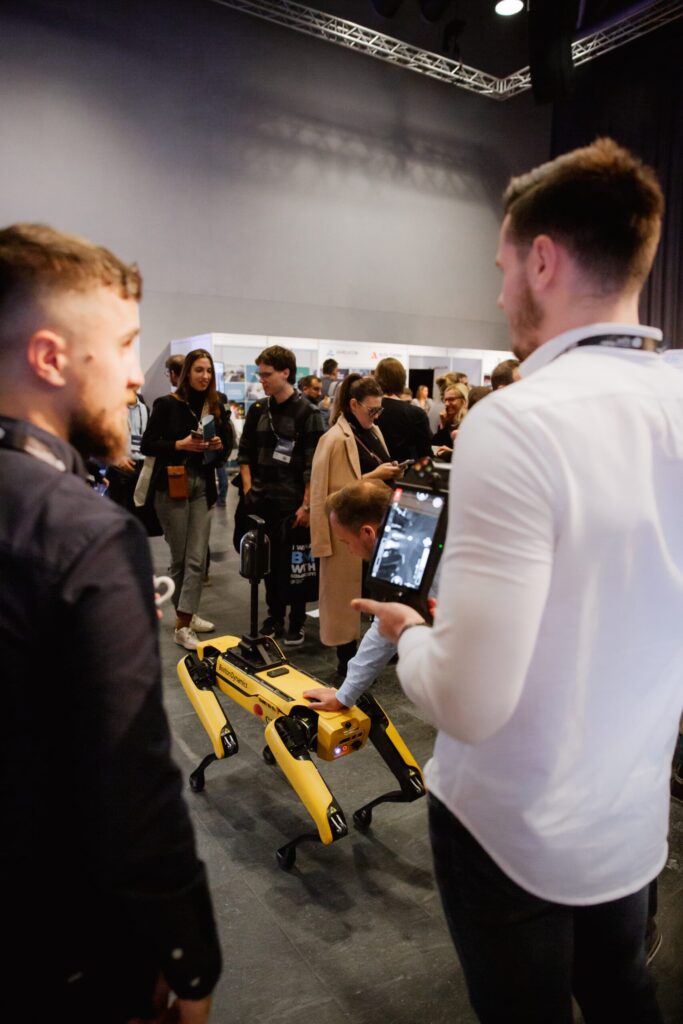
DigiDeck25 is not just a conference – it’s also an opportunity to meet over 20 exhibitors in the inspiring space of the Mozaik Center. Representatives of software solutions, specialized equipment, and companies engaged in design and construction using digital technologies will be available to you. Whether you attend the lectures or stop by one of the exhibition stands, you will find plenty of opportunities for networking, gaining knowledge, and discovering the latest technological trends in construction.
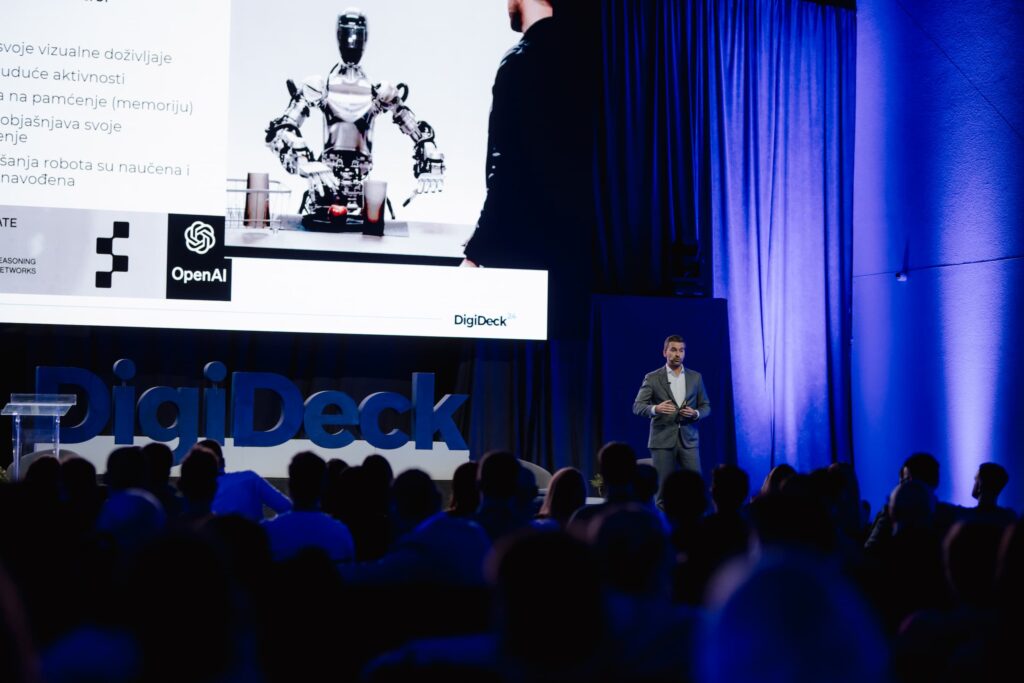
More than 20 speakers from Croatia and abroad are coming to DigiDeck25 to share practical experiences and examples of improving everyday processes in design and construction using digital tools. Take advantage of this unique opportunity to learn more about domestic and international projects where digital solutions have already been successfully implemented.
Thanks to the collaboration with the Croatian Association of Civil Engineers, participants of the DigiDeck25 conference will earn 7 hours of professional development credit as part of the program for professionals working in spatial planning and construction.
At this year’s Education Stage, you can expect multi-hour BIM workshops that provide practical insights into the use of digital tools in everyday work. In addition, you will have the opportunity to attend presentations by leading representatives of software solutions available on the Croatian market, including Revit, Archicad, Arhigon, STAS, FARO, and many more.
This is your chance to get advice firsthand, ask questions to experts, and gain concrete knowledge that you can immediately apply in your projects. The Education Stage is the ideal place for anyone looking to deepen their skills and stay up to date with technological advancements in construction.
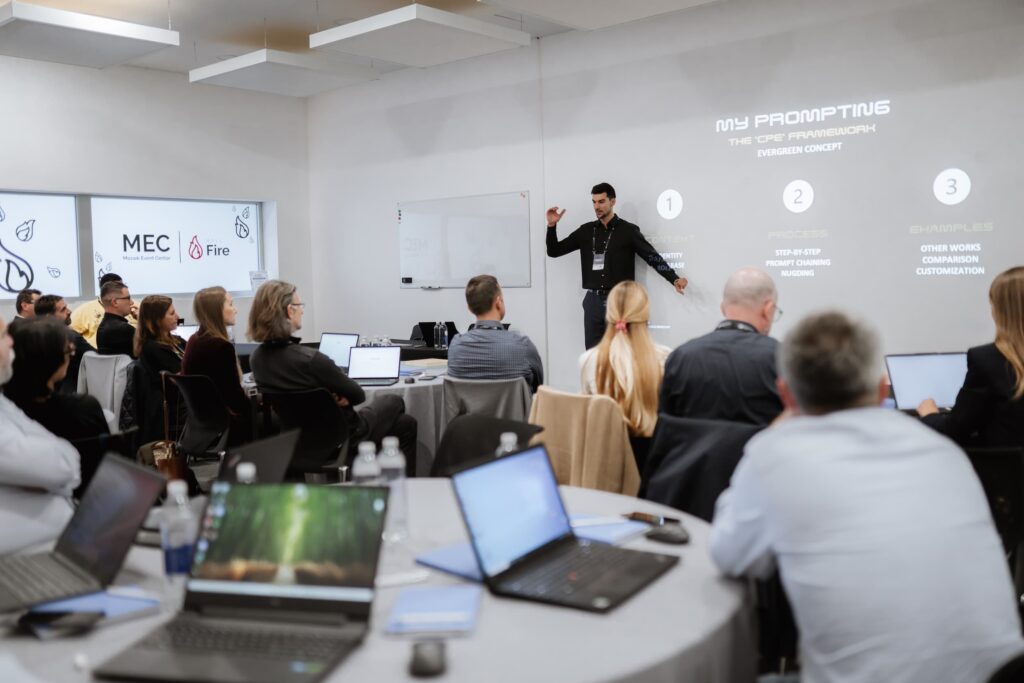
Highlights from Last Year’s DigiDeck – Explore Our Gallery!
In recent years, the DigiDeck conference has rightfully established itself as the most important gathering for all professionals interested in digital technologies in construction. Year after year, this conference not only meets high expectations – it exceeds them. If you want to stay up to date with trends, connect with leading experts, and find inspiration for your own projects, DigiDeck is an event you cannot afford to miss.
DigiDeck is the only event in Croatia dedicated to digital tools and processes in construction. It was created to offer construction professionals everything the market has to offer in one place. We are extremely proud of the organization and of our partners who recognize its significance.
The conference attracts experienced professionals with over 30 years in the industry, as well as students. I believe one of the key advantages of this conference is the strong ‘word of mouth’ – excellent communication and recommendations that encourage people to invite others to attend.
Participating in DigiDeck was truly a special experience – the organization, production, and educational content deserve the highest praise. It is particularly impressive to see a world-class event that simultaneously nurtures local creativity while bringing global knowledge to Croatia.
The lecture focuses on guidelines for the digitization of the construction industry in Croatia, based on insights from European and national research, experiences of domestic companies, and the legislative and strategic frameworks of the Republic of Croatia. Emphasis is placed on the gradual and realistic implementation of digital tools in everyday processes, with recommendations for employee training, system interoperability, and the development of a national construction digitization strategy.
Special attention is given to the regulatory framework: from 2030, the application of the BIM methodology in public projects will become mandatory, requiring clear standards, a national protocol, and continuous training for all stakeholders.
The lecture also illustrates the practical application of digital technologies on construction sites, including IoT sensors, drones, 3D scanning, artificial intelligence, virtual and augmented reality, and digital twins. Participants are provided with basic recommendations and tools that can enhance productivity and efficiency on construction sites in Croatia.
Norveški megaprojekt stiže na DigiDeck25! Signe Marit Dahl Lakså iz tvrtke COWI otkriva kako se metro vrijedan milijarde kruna projektira gotovo u potpunosti bez klasičnih nacrta. Predavanje donosi uvid u digitalne procese i BIM modele koji omogućavaju besprijekornu koordinaciju stotina stručnjaka i desetaka timova. Signe će podijeliti iskustva iz planiranja i izgradnje projekta, lekcije naučene kroz prve godine gradnje i kako su te spoznaje implementirane za buduće faze. Sudionici će moći vidjeti kako digitalni inženjering, integracija podataka i modeli umjesto nacrta oblikuju efikasnost, preciznost i inovativnost u velikim infrastrukturnim projektima.
Project come with thousands of details, conflicts, and decisions that constantly compete for attention, making it difficult to focus on what truly matters. By adopting a data-driven approach, we’ve improved project certainty and made it easier to manage complexity effectively.
In this session, we’ll go over how we shifted from reactive problem-solving to proactive, insight-driven project management.
By seamlessly consolidating data from design models, coordination processes, work plans, and other external sources, we’ve developed powerful dashboards that go beyond simple reporting.
They actively guide decisions, prioritize tasks, and provide real-time project insights.
With this approach, we can focus on key conflicts, track model health, monitor issues across packages, and give senior management a clear and reliable view of project progress.
This lecture explores the full lifecycle of data centre construction-from tendering to turnkey delivery-highlighting how digital tools like BIM are transforming project outcomes. As demand for high-performance data centres grows, efficient and coordinated delivery becomes critical. Attendees will learn how to streamline workflows, enhance collaboration, and reduce risk using integrated digital strategies. The session will focus on practical applications of BIM in design coordination, 4D planning, and stakeholder engagement. It will also address common challenges such as scope creep, miscommunication, and delays, offering actionable solutions. Whether you’re managing tenders or overseeing construction, this lecture provides a roadmap to smarter, faster project delivery.
Ana Tiric will share her experiences with commercial building renovation projects in Dublin, providing insights into the use of BIM and digital tools throughout the entire project lifecycle – from design, through coordination and construction, to handover. The presentation will demonstrate how digital processes enhance communication among stakeholders, optimize costs, and reduce risks, as well as how BIM and modern tools contribute to the successful delivery of projects for global tenants. Ana will also highlight key lessons that are shaping the next generation of renovation and energy retrofit projects for commercial buildings.
In his lecture, Branimir will showcase how digital processes, planning, and collaboration shape contemporary architecture and engineering in the Netherlands, a country renowned for its precision, organization, and innovative approach to space.
The presentation offers a perspective on how digitization is transforming design, decision-making, and project execution, and which lessons from the Dutch system can be valuable in our own context.
At the DigiDeck25 conference, Ante Rašić will share his experience applying the BIM approach during the design phase of a biogas plant, from both the investor’s and designer’s perspectives. Using a real project and measurable results, the presentation provides concrete answers to questions such as how to effectively implement BIM in the design of process and energy facilities, how to address challenges in multidisciplinary coordination, technology modeling, and change management, and where BIM delivers real business value through cost savings, optimization, and risk reduction. Participants will learn the key lessons from this project, what the team would do differently, and recommendations for organizations just beginning their BIM journey.
The presentation will demonstrate how a construction site utilizes a model created by designers from various design offices- a strong example of preparing project documentation tailored to the needs of contractors on site.
The topic is important because it highlights a key challenge in Croatian construction: there are no standardized cost estimates or nationwide material classifications, which complicates work and the implementation of digital technologies. It is also crucial for the development of the Croatian construction sector, supporting the continued individual advancement of modeling within design offices while establishing an organized, state-level system. The existence of regulations, laws, guidelines, and standards would simplify and guide the transfer of digitalization from the design phase to construction, and later to the operational phase.
Based on a current ongoing project, Ivana will share concrete experiences and demonstrate how digital technologies support the implementation of construction supervision- enabling faster access to data, easier coordination, and better quality control. The presentation will also highlight situations where digital tools can complicate the process if organizational structures and communication are not properly adapted, emphasizing the importance of preparation and timely adjustments to changes. Through real challenges and lessons learned, Ivana offers a practical perspective on how BIM and digital technologies are transforming supervision, with a focus on improving project quality, transparency, and efficiency.
Damir Žaja, M.Eng., head of the project office at Klimaoprema, offers a realistic and experienced perspective on how artificial intelligence is shaping the future of design. The presentation explores how AI tools are already automating repetitive processes and creating space for creativity, the challenges and opportunities that come with adopting a new working model in design offices, and what to expect in the next phase when generative AI begins independently creating design models. At a time when artificial intelligence is moving from theory into practice, this lecture provides concrete insights into the changes ahead and the evolving role of engineers in the new digital reality.
The panel “Digital Tools, Analog Limits” explores how much digital advancement can realistically be integrated into daily work, and to what extent technology truly facilitates—or actually limits—project execution. It addresses the challenges of aligning the rapid pace of software and digital tool development with human capacities, skills, and team limitations. Panelists discuss how much time and attention can be devoted to education and skills development, how to manage pressures and deadlines, and where digital tools genuinely enhance productivity versus creating an illusion of efficiency. The panel provides practical insights and examples from various industries and roles, aiming to offer guidance for a balanced approach to digital technologies and maximizing their real value in professional environments.
Increasingly, tender documentation includes BIM requirements—but does their application truly deliver greater transparency, efficiency, and control over public projects, as claimed by artificial intelligence and strategic digital transformation documents in construction?
Or do these requirements hide unclear criteria, additional administrative burdens, and risks for bidders trying to meet BIM expectations without clear guidelines and realistic conditions?
At the DigiDeck25 conference, Filip Andabaka (Salterra) offers a first-hand perspective—from the viewpoint of a bidder who has navigated real projects and faced the practical challenges that BIM introduces in Croatian public procurement processes.
Matjaž Šajn, president of the siBIM association, provides an overview of BIM development in Slovenia, from the first initiatives to the current legal framework and major reference projects. The presentation covers the founding of siBIM and its key achievements, the development of BIM legislation—including obligations and the system for issuing BIM-based building permits—and examples of reference BIM projects in both the infrastructure and building sectors. Participants will gain insight into Slovenia’s path to construction digitalization, including the establishment of a buildingSMART Chapter, membership in the EU BIM Task Group, and the specific circumstances that have shaped BIM implementation from 2015 to today.
The open 1:1 conversation explores how generational differences in the workplace affect teamwork and how they can be turned into a team’s strength. Participants will gain insights into the habits, expectations, and work approaches of Generation X, Xennials, Millennials, and Gen Z, and how these shape hiring processes, employee priorities, and team communication. The discussion also addresses “unrealistic expectations” and the generational gap, offering guidance for understanding and managing these differences in a practical context.
Josip Rukavina will present an innovative methodology for creating digital twins of underwater assets—a technology that is transforming the way infrastructure is monitored, maintained, and managed. The lecture will focus on the use of time-shift inspections to track changes over time, the advantages of high-precision 3D models in detecting cracks, deformations, and risks, and the shift from reactive to proactive management. Through case studies, participants will see how this technology is already enhancing safety, sustainability, and cost efficiency in infrastructure.
The lecture explores how the digital twin becomes a key tool in modular data centers, where every decision- from design to operation- can have a significant impact on performance and reliability. Participants will gain insights into how BIM models can serve as the foundation for a digital twin, what is required to connect design models, sensor data, and simulation tools into an integrated workflow, and the benefits, limitations, and lessons learned from pilot projects. The presentation offers a practical perspective on how BIM evolves into a dynamic, data-driven digital twin and what this means for the future of modular data centers.
The lecture explores how digital construction technologies and artificial intelligence are influencing workflows, decision-making, and project outcomes. Participants will gain insights into current AI capabilities in construction, from predictive maintenance and design optimization to project management, along with a critical review of the benefits and potential challenges. Special emphasis will be placed on emotional intelligence, systems thinking, and human skills such as curiosity, creativity, courage, communication, and empathy, which remain essential for success in an increasingly automated industry.
The lecture explores how digitalization is transforming the process of creating cost estimates and bids, making it faster, more accurate, and simpler. Participants will learn how digital tools save time, reduce errors, and enable collaboration among multiple stakeholders, with the added benefit of access to detailed items provided by manufacturers and suppliers. Instead of manual work in Excel, the session will showcase solutions that connect participants, simplify oversight, and allow the creation of high-quality cost estimates based on relevant market data.
The lecture presents concrete solutions to the challenges of managing documentation in construction projects, where multiple versions, outdated drafts, and overflowing inboxes often lead to delays and incorrect decisions. Participants will learn how AI and specialized digital tools enable real-time tracking and control of documentation, how to avoid outdated and duplicate files, and how field teams and project managers can quickly access accurate information. Special emphasis will be placed on the use of RAG technology, which eliminates AI “hallucinations” and ensures reliable results, connecting theory with practice through real-world examples of working with digital tools.
The lecture explores how machine learning can enhance the understanding of underground geological structures and the design of hydroelectric plants. The focus is on the application of an ensemble model composed of several dozen multilayer perceptrons for classifying subsurface layers, illustrated through the practical example of the Senj 2 Hydroelectric Plant project. Participants will see how this approach helps identify critical areas, assess the reliability of model classifications, and detect key geological features, demonstrating how machine learning moves from theory to concrete engineering solutions that synthesize large volumes of data into a coherent spatial model.
The lecture explores how the new 3D Gaussian Splatting technology enables fast, realistic, and accessible 3D documentation of spaces without complex and costly processes. Participants will gain insights into the fundamentals and advantages of this technology, its practical application using handheld mobile scanners, and concrete examples from architecture, construction, and surveying—from capturing existing structures to visualizations for design and renovation. The presentation demonstrates how 3DGS provides a more efficient and photorealistic alternative to traditional spatial documentation methods.
The lecture demonstrates how 3D laser scanning and handheld ground-penetrating radar are transforming the preparation and execution of renovation projects, enabling precise, fast, and comprehensive spatial measurements. Participants will gain insights into point cloud processing, from raw data to optimized models ready for further work, as well as the use of GPR for detecting reinforcement and analyzing walls without damage. The presentation also offers tips and best practices to avoid common mistakes, showing how the combination of these technologies enhances safety, reduces risks, and improves efficiency at all stages of a project.
The workshop “My Template is Better Than Your Template” offers a practical and interactive approach to creating and improving BIM templates that truly work in projects. Through group work, mentorship, and real-world examples, participants will learn to identify key elements of a template, compare different approaches, and design a template that supports the project from concept to handover. The workshop is aimed at anyone looking to master the fundamentals of BIM processes, enhance the efficiency and quality of their projects, and gain practical tools and examples for everyday application.
The workshop “I Need BIM, PART 1” provides hands-on experience in coordinating a BIM project through role-playing and an interactive methodology. In just 90 minutes, participants will experience how to define project goals, understand the needs of all stakeholders, agree on processes and coordination, and see why quality is key to success. The workshop collaboratively develops a draft of a real EIR and BEP, demonstrating that BIM documents are not just paperwork, but the outcome of agreement among all project participants.
The lecture demonstrates how to systematically verify the quality of information within a BIM model using visual and tabular tools already available in BIM software. Participants will learn how to filter and review data for quick checks, adapt available tools to project needs, and develop a clear methodology for systematically monitoring the accuracy and reliability of information. The presentation provides practical tips for saving time, efficiently managing large datasets, and building more reliable BIM models.
The lecture demonstrates how a unified software solution for construction companies can improve project management and resource planning, reduce errors and delays, and enable systematic and precise operations. Participants will gain insights into the benefits of using integrated ERP software, the challenges of implementation and strategies to overcome them, as well as a practical overview of introducing the software in a large construction company- from initial steps to full integration. The presentation provides concrete examples of how digitalization and smart project management can boost productivity and reduce risks in everyday operations.
The lecture demonstrates how Revit Keynotes can become a crucial tool for structuring and standardizing information within a BIM model. Participants will learn how to link geometry with an informational layer that defines meaning, function, and model interoperability, and how to use Keynotes for element management, categorization, automated reporting, and effective communication within the BIM team. The presentation includes practical examples that help create more understandable, sustainable, and efficient models that support decision-making and collaboration throughout all project phases.
Norwegian megaproject comes to DigiDeck25! Signe Marit Dahl Lakså from COWI reveals how a billion-krona metro is being designed almost entirely without traditional drawings. The presentation offers insights into digital processes and BIM models that enable seamless coordination of hundreds of specialists and dozens of teams. Signe will share experiences from the planning and construction of the project, lessons learned during the first years of building, and how these insights are being applied to future phases. Participants will see how digital engineering, data integration, and models instead of drawings drive efficiency, precision, and innovation in large-scale infrastructure projects.